

Tanzania · East Africa
Trip code: KCKilimanjaro - Lemosho Trek
From
A$5,030
Was A$5,350 Save A$320
Prices and availability are confirmed by our regional travel experts.
View dates & prices Call to bookYour adventure
Kilimanjaro - Lemosho Trek
Trip highlights
Why we love this trip
Gradual ascentOur seven-day ascent lets you slowly acclimatise to the changing altitude, helping you reach the summit and enjoy the climb.
Experienced crewOur trek is led by world-class leaders and accompanied by a full team of guides, porters and cooks.
Wild campsSleep on Kili's slopes as we wild camp with panoramic views of the surrounding plains.
Day by day
Itinerary
Select an option to view its itinerary. Contact us to confirm which itinerary applies to your departure.
Included Meals: Dinner


Included Meals: Breakfast, Lunch and Dinner

Included Meals: Breakfast, Lunch and Dinner

Included Meals: Breakfast, Lunch and Dinner
Included Meals: Breakfast, Lunch and Dinner
Included Meals: Breakfast, Lunch and Dinner
Included Meals: Breakfast, Lunch and Dinner

Included Meals: Breakfast, Lunch and Dinner

Included Meals: Breakfast, Lunch and Dinner

Included Meals: Breakfast
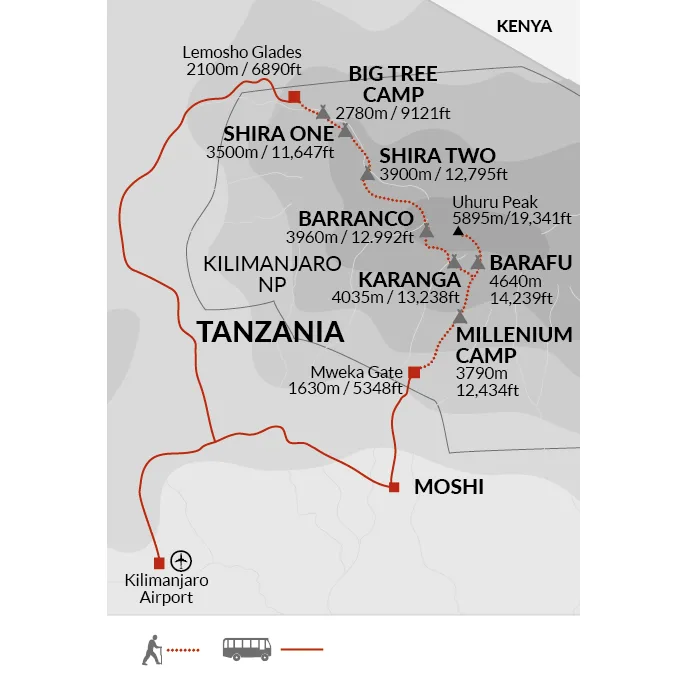
Route overview
Trip map
Activity information
Walking information
Walking
Grade: Challenging and Tough
Maximum altitude: 5,895 m
Included in your trip
What's included
Meals
- 9 breakfasts
- 8 lunches
- 9 dinners
Staff
- Explore Tour Leader, Porter(s), Trek Crew, Cook, Driver(s)
Transport
- Bus
Accommodation
- 2 nights Comfortable Lodge
- 7 nights Simple Camping
Our Kilimanjaro trek is camping based and conditions on the mountain are basic. We use two-man tents which are put up and taken down by our amazing porter team. There is a mess tent where we eat breakfast, lunch and dinner, as well as tea and refreshments. Each campsite has basic long drop toilets but we also carry a toilet tent with chemical toilets. There are no permanent washing facilities at the camps and water is limited.
In Moshi, we stay at the Weru Weru River Lodge, a three-star property with good facilities including an outdoor swimming pool with views of Mount Kilimanjaro. The lodge also has a restaurant and bar as well as a spa.
Suitability
Is this the trip for you?
Climbing Kilimanjaro is a real achievement but it's tough going. We've graded the treks on our Lemosho route trip as challenging. You should have a good level of fitness to take part.
We make a slow and safe ascent over ten days, giving you time to acclimatise to the increasing altitude. Our steady pace gives you a better chance of succeeding to the summit.
The safety of our trek has been assessed by an independent medical specialist. We also carry oxygen cylinders and Gamow bags on all departures for emergency use.
Our local partner is a long-established and reputable Kilimanjaro specialist and our Kili trek leaders are regularly voted as amongst the best in the world.
Our trekking staff are all from the local area and the revenues from our treks benefit the local economy. Part of the proceeds of our climb also help the 'Say No to Malaria' campaign.
Minimal travelling by vehicle. We’ll be walking from one overnight stop to the next, covering almost our entire journey on foot.
The Kilimanjaro Park fee is included in the trip price.
Plan your departure
Dates & prices
Choose a date below, then contact our team to confirm the latest price, availability and booking details.
| Departure | Return | Price | Booking |
|---|---|---|---|
| 22 Oct 2026 | 31 Oct 2026 | A$5,030Was A$5,350 Solo roomA$360 | Call to book |
| 14 Jan 2027 | 23 Jan 2027 | A$6,180Was A$6,610 Solo roomA$430 | Call to book |
| 18 Feb 2027 | 27 Feb 2027 | A$6,440 Solo roomA$440 | Call to book |
| 24 Jun 2027 | 03 Jul 2027 | A$6,610 Solo roomA$430 | Call to book |
| 08 Jul 2027 | 17 Jul 2027 | A$6,610 Solo roomA$430 | Call to book |
| 12 Aug 2027 | 21 Aug 2027 | A$6,610 Solo roomA$430 | Call to book |
| 09 Sept 2027 | 18 Sept 2027 | A$6,610 Solo roomA$430 | Call to book |
| 21 Oct 2027 | 30 Oct 2027 | A$6,610 Solo roomA$430 | Call to book |
| 23 Dec 2027 | 01 Jan 2028 | A$6,610 Solo roomA$430 | Call to book |
Departure
22 Oct 2026
Return 31 Oct 2026
From
A$5,030
Was A$5,350
Departure
14 Jan 2027
Return 23 Jan 2027
From
A$6,180
Was A$6,610
Departure
18 Feb 2027
Return 27 Feb 2027
From
A$6,440
Departure
24 Jun 2027
Return 03 Jul 2027
From
A$6,610
Departure
08 Jul 2027
Return 17 Jul 2027
From
A$6,610
Departure
12 Aug 2027
Return 21 Aug 2027
From
A$6,610
Departure
09 Sept 2027
Return 18 Sept 2027
From
A$6,610
Departure
21 Oct 2027
Return 30 Oct 2027
From
A$6,610
Departure
23 Dec 2027
Return 01 Jan 2028
From
A$6,610
Practical information
Your questions answered
Information for: 2026
Excursion to Arusha National Park including park fees and lunch, Approx. $122-400 USD - depending on numbers (minimum 2 persons). This excursion runs from approximately 0630-1300hrs and is dependent on passenger flight times.
Massage - Relax after your trek with a massage at the Weru Weru River Lodge Spa. Prices range from $60 - $90 USD and can vary from 60 minutes - 90 minutes.
Payments by cash or card.
Local crew
After consultation with local porter protection groups and our agent in Tanzania, you should accordingly allow US$200-250 per person depending on group size for group tipping on this tour.
It would be advisable to have this amount in denominations of 5,10 and 20 dollar notes for ease of distribution.
Tour leader
Tanzania
Currency: Tanzanian Shilling (TZS)
US Dollars are preferable. Please be aware that any notes issued before 2006 will not be accepted
Where to change: Banks or 'Forex' offices only in main towns/cities. Your Tour Leader will advise you on arrival.
ATMs: Major towns and cities will have ATMs available.
Card notes: Credit cards are generally not accepted.
Credit cards accepted: No
Being properly equipped is one of the keys to a successful trek. Use the following check list and notes to be sure that you have what you need for the actual trek.
Jacket - After sunset, temperatures can fall below freezing. A very warm jacket is the most convenient way of keeping warm when the temperature drops. Down jackets are recommended especially for the summit attempt.
Waterproofs - Breathable jacket and trouser waterproofs made from material such as Goretex not only protect against rain and wind, but also stops you from overheating. They 'breathe' and avoid the condensation that you may experience from nylon waterproofs.
Long trousers - For everyday walking, light trekking trousers are the most suitable. Jeans are not recommended as they are often difficult to walk in over longer distances and become cumbersome and cold when wet.
Fleece jackets: Fleece jackets are essential as nights can be very cold at altitude. Make sure that your waterproof jacket is loose enough to wear over your fleeces.
Thermal underwear/base layers - Long sleeve tops and long-john legging thermal underwear is essential. Cotton clothing like t-shirts are not suitable or recommended as a base layer as they do not wick away any moisture from the skin. In extreme cold, this could lead to hypothermia. It can also contribute to chaffing of the skin in sensitive areas leading to discomfort and skin irritation.
Shorts - Shorts can be very comfortable to walk in but you must carry long trousers with you in case you get either sunburned or cold!
Waterproof gloves; a warm scarf & a warm hat - Heavy duty windproof gloves or mittens (such as ski gloves) and thinner liner gloves are essential. Also bring a scarf to cover your neck and a warm balaclava or a warm hat.
Buff - Useful protection against dust kicked up from the scree slopes of the summit
Note re: summit night clothing - Climbing Kilimanjaro is the equivalent of trekking from the Equator to the Pole. It is essential that you have the proper equipment and clothing to ensure you enjoy the trek and also give yourself the very best chance of reaching Uhuru Peak. After many years of trekking and reaching the summit of Kilimanjaro, we strongly recommend that you should wear the following for your summit night
Torso: You should have six or seven layers of clothing covering your chest depending on your kit specifications. Starting from your base layer to the outer shell, you should wear a long-sleeve thermal underwear layer; a comfortable long sleeve shirt; a jersey; a thin fleece; a thicker fleece and a thick waterproof and windproof outer shell that may contain a fleece lining. If you have a down jacket you may want to decrease this by one layer.
Legs: You should wear three layers of clothing covering your legs. Starting from your base layer to the outer layer, you should wear long-john thermal underwear; trekking trousers and a waterproof and windproof outer shell.
Extremities: Your head must be covered by a balaclava or a warm hat and your neck should be covered by a scarf. Your hands must be covered with thinner liner gloves with thick waterproof and windproof gloves on top. You must have thick clean warm socks for summit night. You might also wish to bring hand warmers for additional warmth for summit night. Most well stocked pharmacies/outdoor stores will have these available.
Trainers or trekking sandals - Useful in towns and when travelling and relaxing around camp. It is worth bearing in mind that trekking sandals afford you little protection from stubbing your toes when walking around rock-strewn campsites at night.
Socks - It is best to wear a pair of liner socks under a pair of fairly thick loop stitch socks. This helps to protect your feet against blisters. Avoid nylon socks, they are abrasive, don't breathe well and can cause blisters.
Personal equipment you will need to take on trek:
Sleeping bag - As you do not carry it yourself, this may be down or synthetic, but it must be 4-season comfort rating (temperature -10 degrees celcius). A silk or fleece liner helps to keep your bag clean and adds extra warmth.
Sleeping mat - Whilst Vaude sleeping mats are provided, they are lightweight and fairly thin. You therefore may wish to bring your own inflatable thermarest for added comfort and a good night's rest.
Sleeping aids - Some people find it difficult to sleep at altitude. You may find ear plugs and an eye mask useful at night.
Trekking poles - Strongly recommended.
Water bottles or Platypus/CamelBak hydration system - During the trek you will be supplied with filtered water each morning in camp but this will still need to be purified. Take at least 2 x 2 litre personal water bottles or a system that allows for this much water. If you elect to use a hydration system with a tube then it is essential that the bladder and tube are insulated for high altitude and below freezing temperatures.
Explore have partnered with Water-To Go who supply 75cl personal water bottles with an in-built filter that eliminates 99.99% of all microbiological contaminants including viruses, bacteria, chemicals and heavy metals. https://watertogo.eu/partnerships/explore/
If not using a filtered bottles, a personal supply of tablets/drops (approximately 40 tablets) for your water purification system is essential and should be brought with you as they are not easy to find in Moshi. Powdered fruit juice can be used to disguise the taste and this can be purchased in Moshi.
Sunglassesnow goggles - Essential for protection against UV rays and glare at high altitudes.
Sun hat, high factor sun cream/block and lip salve - Choose a high factor suncream (factor 30 or more) to protect your skin against the sun at high altitudes. A combination sunblock/ lipsalve is ideal for facial protection.
Torch/batteries/bulb - A head torch is essential at night in the camp and for lighting your way on the night time summit ascent. Bring plenty of spare batteries and a bulb. There are no facilities on the mountain to recharge any digital equipment.
Personal toiletries - Essentials are toothbrush/paste, soap (preferably biodegradable), face cloth and trek (quick dry) towel.
Personal First Aid Kit - on each trek a first aid kit is carried but you should have your own blister kit, supply of plasters, aspirin and other essentials.
Also please bring antibacterial hand wash for daily usage.
Please do not give medicines to local staff without consulting the tour leader.
Personal supplementary snacks - Although sufficient food is supplied on this tour, we recommend that you bring some high energy snacks like cereal bars and chocolate (sweets if you are lactose intolerant) with you. Dextrose and mint cake are especially good for summit night.
Swimming costume - The hotel in Moshi has a pool.
Two man tents, dining tent, toilet tent and all cooking and kitchen equipment are provided by Explore once you are on the trek.
Equipment rental in Tanzania - the following items are available for hire locally and prices stated are for the duration of the trek. Please advise Explore in advance of your trek so prior arrangements can be made with our local agent in Moshi :-
Trekking poles - $15 per pair
Four-season sleeping bag - $20
Air mattress (self-inflating Therm-a-Rest style) - $10
Equipment hire and trek training days in the UK - Trek Hire UK hire out a wide range of kit including quality sleeping bags, down jackets, therm-a-rest sleeping mats and walking poles http://www.trekhireuk.com. They also run regular trek training and preparation days from their base in the Surrey Hills, ideal for getting an indication of your overall fitness level and also covering advice on kit and altitude.
Drones - Are not permitted in any National Park in Tanzania without a permit. Permits cost approximately US$250 per 24 hrs. Please advise us at time of booking if you wish to take a drone with you into the National Park, as permits are difficult to obtain. If you launch a drone without a permit this will be confiscated by the Park officials.
Plastic Bag Ban:
With effect from 01 June 2019, it is illegal to use, manufacture and/or import plastic bags into Tanzania and Zanzibar. Any person found with plastic bags of any type including shopping bags on arrival into the country can receive a heavy fine. Small plastic bags used for hand luggage toiletries are permitted but must be in a reusable condition and not disposed of in the country. Please ensure you do not have any non-permitted types of plastic bag in your hand luggage or luggage. Any plastic bags obtained whilst travelling are disposed of before arriving into Tanzania or are surrendered at the designated desk available at all entry points into the country.
Luggage on tour
Main baggage - The item of luggage used to carry all your belongings in the hold of the plane and used to store all of the items that you don't need on trek. This can be left behind at the group hotel used prior to the trek.
Trek kitbag - Before leaving Moshi there is time to re-sort luggage into what you need on trek and what can be left in Moshi. Think about what you are taking on trek (remember your sleeping bag) and then think how big your kit bag needs to be. An ex-army type can usually be obtained cheaply. A nylon or canvas bag with a zip along the top is also suitable. Whatever you choose, it must be strong and waterproof, but the porters will carry your kit in heavy duty outer bags for added protection. Soft luggage is essential as framed rucksacks are unsuitable.The weight limit for bag and its contents must not exceed 15 kg but you will probably find that you do not need this much.
Daysac/Rucksack: 30-35 litres recommended. During the course of a trekking day, you do not have access to the luggage which is being carried for you by the porters. In any mountain region the weather can change rapidly and you must be equipped for this eventuality. Your daysac should therefore be large enough to carry waterproofs, fleece jacketweater, long trousers (if walking in shorts), warm hat and gloves, sun hat, sun cream, water bottle (minimum 1 litre) and your camera. Most people normally find that this adds up to about 2 to 3kg. Other optional items in a daysac might be a diary or a book to read at lunch time. We advise you to take a waterproof rucksack cover or alternatively line the sack with a large dry sack to keep the contents dry.
Luggage limit: 20KG
Tanzania
A single-room option is available for every night of this itinerary. Subject to availability for your departure. A single-room supplement applies.
Tanzania: A single visa is required by UK, New Zealand, Australian, US & Canadian citizens. Single entry visas only can be arranged on arrival, but due to queues at immigration we recommend for the visa to be arranged in advance.
An E-visa for Tanzania can be obtained prior to departure via the e-visa website: http://www. immigration. go. tz.
Click on the e-Services tab and then select Online
Visa Application, please ensure you read the
Visa Application Guidelines before applying for your e-visa.
Please refer to the Explore visa letter you will receive for information required to complete your e-visa application. You will need to print a copy of your e-visa approval letter and present this with your passport and final documents at your entry point into the country. The approval letter takes approximately 10 days to approve if there are no queries on the application. We therefore advise for you to apply at least 15 workings days prior to travelling. Please ensure you have enough validity left on the visa through to the end of the tour before you travel. The Tanzanian High Commission in London no longer processes or issues visas.
American nationals are required to apply for a multiple entry e-visa for all tourism visits to Tanzania; the ordinary single entry e-visa is unavailable for Americans to apply to.
From October 2026, all travellers visiting Mainland Tanzania or Zanzibar must buy compulsory travel insurance before travelling, and this must be purchased through The Zanzibar Insurance Corporation online prior to travelling.
The fee for this is US$44/pp Travellers must pay the insurance fee regardless of whether or not they have obtained travel insurance elsewhere.
Passports must have a minimum validity of 6 months and at least 1 blank/unused page at time of travel.
Plastic Bag Ban: With effect from 01 June 2019, it is illegal to use, manufacture and/or import plastic bags into Tanzania and Zanzibar. Any person found with plastic bags of any type including shopping bags on arrival into the country can receive a heavy fine. Small plastic bags used for hand luggage toiletries are permitted but must be in a reusable condition and not disposed of in the country. Please ensure you do not have any non-permitted types of plastic bag in your hand luggage or luggage. Any plastic bags obtained whilst travelling are disposed of before arriving into Tanzania or are surrendered at the designated desk available at all entry points into the country.
Tanzania
Plastic bag fees Please do not bring plastic bags into Tanzania as this could incur a fine. etc etc